Stay Woke by Tehama Lopez Bunyasi & Candis Watts Smith
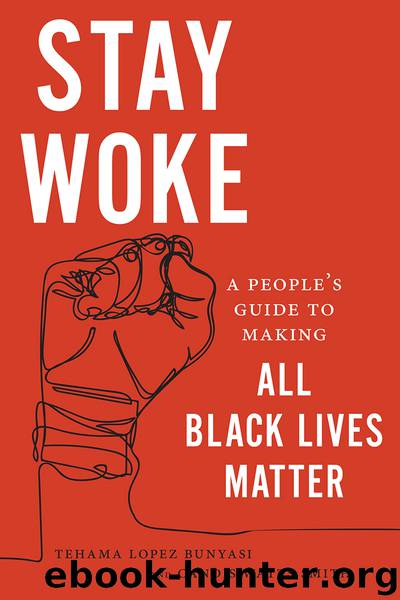
Author:Tehama Lopez Bunyasi & Candis Watts Smith
Language: eng
Format: epub
Tags: SOC001000 Social Science / Ethnic Studies / African American Studies
Publisher: NYU Press
—
“It Doesn’t Matter If You’re Black or White or Green or Blue!”
Colorblindness has become the dominant racial ideology in the US (though not the only one), putting us in what the anthropologist Lee Baker calls the “color-blind bind.”5 Sociologists like Ruth Frankenberg explain that a colorblind ideology is a “mode of thinking about race organized around an effort not to ‘see’ or at any rate not to acknowledge race differences,” because this is perceived as the “‘polite’ language of race.”6 A colorblind narrative suggests that we can get rid of the last, lingering vestiges of racial inequality by ignoring race altogether. There are two assumptions here. First, the logic erroneously presumes that there is only a “little bit” of racism left, and second, it suggests that ignoring the problem will solve it. Taken together, these assumptions serve to perpetuate racial inequity because they lead us to falter in addressing the issue for what it is: racial inequity.
Though it has become a common belief that being colorblind is best for everyone, colorblindness is actually an evolved form of previous, harmful racial ideologies and attitudes. This ability to transform and appropriate the values of contemporary (middle-class) whites and to discard the parts that would make it irrelevant or too obviously transparent is what makes some people call racism a “scavenger ideology.”7 We have to keep in mind that a racial ideology is simply a story we tell ourselves to explain what we see in this world. So during the “Jim Crow” racism era, people relied on a narrative that suggested that Black folks’ subordinate social, political, and economic status resulted from their inherent inferiority. After Jim Crow was dismantled through civil-rights-era policies—such as the Civil Rights Act of 1964, the Voting Rights Act of 1965, and the Fair Housing Act of 1968—many whites, arguing that the playing field was now leveled, became indignant over additional race-conscious efforts, such as affirmative action, which sought to close the racial disparities in opportunity. These racially resentful people asserted that if any trace of the racial inequities that were developed during the previous four hundred years still existed, it was because Black people did not live up to their newly presented opportunities to succeed. Today, colorblindness leads people to rely on logic that claims that since race shouldn’t matter, it doesn’t matter; in fact, some believe we would be better off if we just didn’t “see” race altogether.
The claim to “not see race” does us all a disservice because race does shape the lives of every living person in the United States. Relatedly, many people on the left claim that “identity politics” is the opposite of colorblindness and thus is harmful because white nationalists use the same identity-based “rationale” as people of color to demand redress for their perceived loss of racial privilege. This logic and argument are lazy and careless. As is often said, when you’re accustomed to privilege, equality feels like oppression. If we shift our perspective from a position of privilege to that
Download
This site does not store any files on its server. We only index and link to content provided by other sites. Please contact the content providers to delete copyright contents if any and email us, we'll remove relevant links or contents immediately.
| General | Discrimination & Racism |
Nudge - Improving Decisions about Health, Wealth, and Happiness by Thaler Sunstein(7712)
The Fire Next Time by James Baldwin(5454)
iGen by Jean M. Twenge(5419)
Adulting by Kelly Williams Brown(4582)
The Sports Rules Book by Human Kinetics(4398)
The Hacking of the American Mind by Robert H. Lustig(4387)
The Ethical Slut by Janet W. Hardy(4263)
Captivate by Vanessa Van Edwards(3845)
Mummy Knew by Lisa James(3695)
In a Sunburned Country by Bill Bryson(3548)
The Worm at the Core by Sheldon Solomon(3493)
Ants Among Elephants by Sujatha Gidla(3472)
The 48 laws of power by Robert Greene & Joost Elffers(3305)
Suicide: A Study in Sociology by Emile Durkheim(3025)
The Slow Fix: Solve Problems, Work Smarter, and Live Better In a World Addicted to Speed by Carl Honore(3015)
The Tipping Point by Malcolm Gladwell(2931)
Humans of New York by Brandon Stanton(2876)
Get What's Yours for Medicare: Maximize Your Coverage, Minimize Your Costs by Philip Moeller(2767)
Handbook of Forensic Sociology and Psychology by Stephen J. Morewitz & Mark L. Goldstein(2709)
